Friday, April 22, 2016

Stitching Stories: An Interview with Margriet Hogue of The Essamplaire!

What a special treat!  We meet Margriet of The Essamplaire about learn about how she got started in stitching and her love of samplers and reproducing them.  While our journeys are all similar we have all followed a different path to get to the same place, a love of reproduction samplers.    


Margriet, how old were you when you first picked up a needle and who taught you to stitch? 

*My mother taught me to stitch around age six or seven, the first thing I did was a stamped pattern. 

Do you remember what sampler you stitched first? 

*It was a sampler from a Dutch magazine and can't remember the name of it but it wasn't very large.

When do you find time to stitch?  Do you sit in a set place and have favorite tools on hand? 

*If I'm on a deadline I will stitch all day but generally I will stitch in the afternoon and in the evening. I move to different places for stitching, especially if I'm doing very fine work, then I tend to sit in front of a window for better light.

Is there a stitching method that you prefer, such as stick and stab technique, or a sewing stitch?  

*I learned how to stitch using the sewing method and generally use it unless it is something that needs to be stretched then it's two handed and more often than not I end up with loops on the back that I end up stitching over.

Do you have favorite stitching supplies?  A favorite linen?  Do you prefer to use silk threads?  

*I pretty much always use silk threads, I find that I'd rather use those if I'm spending all this time on it.  I like Zweigart linen the most.

Is there a specialty stitch or embroidery technique you enjoy most?  

*I like most stitches but to be honest queen stitch is my least favourite, looks nice but takes too long.

How did The Essamplaire start? 

*I came across a sampler in a Dutch magazine and made it and then another one from a Dutch magazine.  Then, I bought a kit, which I never did finish and thought I can do this.  Whenever we would travel I'd make appointments with museums to look at their samplers and get permission to reproduce them.  I started buying antique samplers, as well, and reproduced those.  Early on I sent images of six samplers I had done to Country Living magazine and they featured them in one of their issues and the rest as they say is history!

What do you look for when choosing a sampler to chart for your collection?     

*It has to be appealing to the eye, some have a naivety to them or a folky look and others are just pretty to look at.  I also look to see if they belong to a particular school or area and preferably they have a variety of stitches.

What is your favourite period of sampler-making and why?  Which designs appeal to you the most?

*Can't say that I have a favourite time period, it changes from time to time.  For a while I really liked 17th century samplers and then after stitching those for a bit I need a change and do something a little simpler and less time consuming.  But I do go back to them.  I always like Scottish and Dutch samplers. Love some of the American ones.
  
Has working with reproduction samplers given you any new insight into the lives of the girls and women in the 17-18-19th centuries that you did not realize before? 

*You can't help but learn about the girls and women's lives that stitched these samplers, you wonder where they were, physically, while stitching, if they enjoyed it or was it something that had to be done.  Some girls hated it, I'm sure they would rather have been outside running around.

What aspect(s) of working with early textiles appeals to you the most? 

*The history behind them.

How do you display your stitched samplers?  Do you frame them?  Hang them singularly or in groupings? 

*I used to frame them but now they are rolled up or laying flat in an acid free box.  I do have some grouped together on a staircase wall.

Do you collect antique samplers? 

*I do collect samplers, I used to try and have one of every country and then that got a bit out of hand and I sold most of those and have focused on Dutch samplers only and now in particular only orphan samplers from one particular orphanage.

Apart from samplers do you collect anything else? 

*Some pottery and art.

Do you enjoy any other types of hand work? 

*I used to weave and knit but gave those up as it bothers my shoulder too much, occupational hazard from repetitive movement.

What other hobbies or interests do you enjoy? 

*Love painting, I paint abstracts.  It's a nice change from stitching.

Any guilty secrets to confess? 

*I do drink tea and coffee when stitching and once red wine, which went down the wrong way and ended up all over the sampler.  Fortunately it came out as I ran it under cold water immediately.  I now do have some longer jumps on the back, I generally try not to have them longer than three stitches but they are longer from time to time.

What has been your worst needlework disaster?  

*See above, the red wine over everything!

Do you have a favorite sampler or one that has special meaning to you? 

*Not really, they are a favourite when I'm working on it.

Are you currently working on sampler or special project?  What do you most enjoy about it? 

*Currently working on Olivia Rebecca Parker, a sampler from the collection of Winterthur and stitched by a black girl.


Thank you so very much, Margriet!  It is wonderful to hear about how you got started and learn more about The Essamplaire.   Please visit The Essamplaire website at www.theessamplaire.com to browse their full collection of antiques and samplers.  There are so many beauties, they will be hard to resist!   Margriet also offers online sampler classes, a great way to learn advanced techniques!  


Sunday, April 10, 2016

Stitching Stories: An Interview with Robin!

For our April interview we meet with Robin of Montana! 

Robin truly loves needlework in many forms and we are delighted that she is sharing her works with us today!  From beginning to end, it is a feast for the eyes in color and craft, of samplers, quilts, knitting and more.  Enjoy!   


How old were you when you first picked up a needle and who taught you to stitch?

*I didn’t have anyone in my life while I was growing up that did needlework. It was all pre-destined in my mind and hands that I would do such activity. I knew there was something, but how does a small child put their thoughts into context of what it all means? Honestly, at 6 or 7 years old I used to cut out the quilt block patterns from the Kansas City Star newspaper when it would arrive at my grandparents house in southeast Colorado. I didn’t know what I was going to do with them, but I knew I wanted them and I knew I loved the word “quilt”.

We had a small fabric store in the downtown block that was called Shulls Fabrics and a Woolworth Five and Dime store that had “embroidery stuff”.  I went into Shulls as a small child and I can remember seeing the bright cotton embroidery threads and patterns, yarn, and fabric (to the ceiling). Mr. Shull was a German speaking gentleman that cut your fabric for you. I remember making a bee line for it when I was about 10, with my babysitting money in my pocket, and I bought a blue Susan Bates hoop, DMC or J&P Coats cotton, a package of two pillowcases, needles and I was off and running. The package had instructions on how to do the stitches and that is how I learned. I would eventually buy a stamped “sampler” with cross stich on it or crewel stitches, but I don’t know what ever happened to those. My mother was not a saver, she was a place for everything and everything in its place lady and there were no mice in our house because the floors were spic and span.

That same year I taught myself to knit. There went the rest of the babysitting money. The library was my friend for knitting stitch dictionaries.

I have to tell you a story. My brother and I were 18 months apart, which made us mortal enemies. One year, while I was in high school, he drew my name for the Christmas gift exchange. When I opened it and saw the stamped dresser scarf, cottons, needles, hoop, I’m sure I cut my eyes at him and mumbled thank you; but inside? It was THE best gift I could have ever gotten.   I knew my mom was behind it, but it was never spoken out loud; my brother got one point.

Right before leaving for the U.S. Navy in 1979, I became friends with a neighbor lady who had shown me all of her handmade quilts in her home. I was speechless. Now I knew what I would do with the quilt block patterns…but I was out of time. It was time to leave.  Fast forward through boot camp and schooling and I went to my first duty station, Guam, as a Cryptologic Operator. There was a community center on our base that was advertising quilt making! Eureka! I enrolled immediately and the rest is history. My cross stitching method is based on the hand sewing of quilt seams and quilting that I have done all of these years now.  While on Guam, cross stitching was just starting to become popular and I played around with a few smalls, but it didn’t last. Then the Paula Vaughn patterns came out in the 1980’s, with some linen, and I tried a few, but never finished them. That was the extent of cross stich until now; until reproduction samplers.

Do you recall the first sampler that you stitched?

*Yes, because it was so recent! The House on the Green Lawn Sampler by Ramsgate Ltd.


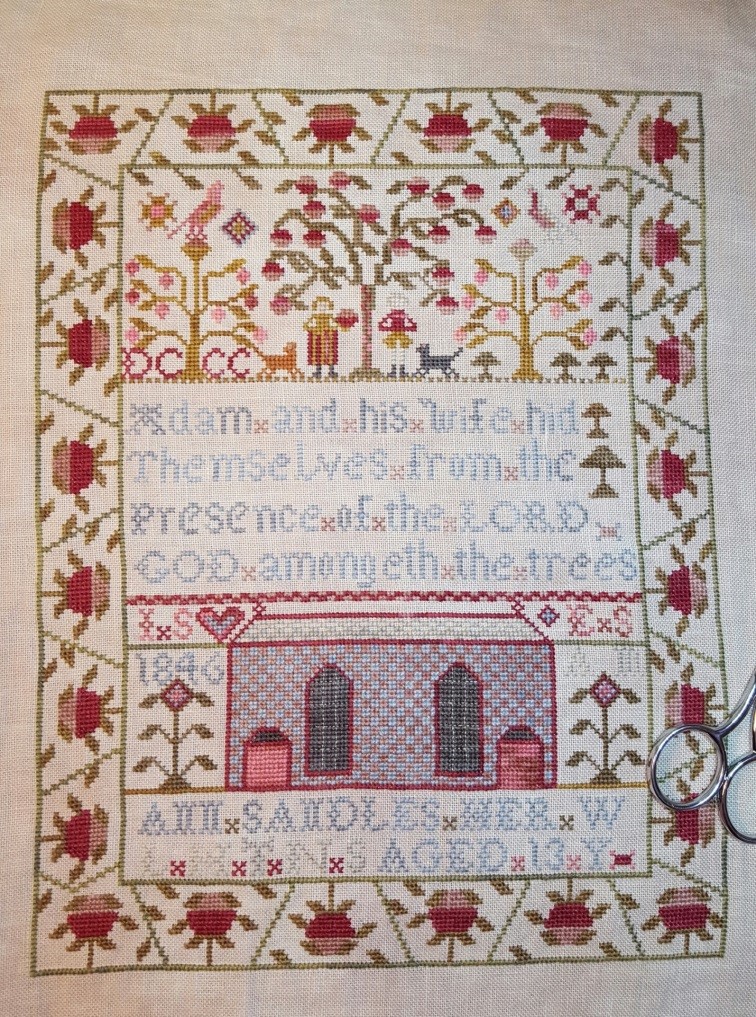
I found this kit (pattern and fabric) in an antique store in Alpharetta, Georgia in 1987.  Since it was cute and it was related to needlework, it came home with me, unopened.  I was too busy quilting and knitting.  Fast forward 25 years and as I was scrolling through the blog roll on the blogs I read, I had to hit the mouse brake! I had just seen the most beautiful piece of something in my life. It was Ann Dale by Shakespeare’s Peddler and it had been stitched by a knitter, who I am sorry, I can’t remember whose blog I saw it on.  I started searching for this old kit I had stashed because I thought if I stitched it and it was something I really enjoyed doing, then I would purchase my first pattern/linen/threads to do an Ann Dale.  I did love the process and that began my journey into samplers.  I did not do Ann Dale next, though, I stitched Ann Sandles. Because, you know, once you have started collecting patterns, there are all kinds of possibilities!


When do you find time to stitch?  Do you sit in a set place and what tools do you like to have on hand?  

*I stitch every night, from about 7 -10. On the weekends I like to start my day in the stitching room and will pop out for breakfast but then stitch until lunch.

I use the regular tools; hoop, scissors, size 28 needles, seam ripper, Ott Light, oh, and I can’t forget the stitching glasses. I keep all of this on a wooden table tray that I can carry back and forth to whichever area I am going to be stitching. There is a wooden cup screw in the side of it on which I hang my thread bags. My Book of Days Needlework Calendar is always within reach.

I have two stitching places. One is in my stitch room, in the corner, with the light over my shoulder and my Sirius radio playing Frank Sinatra and the mess in front of me, sometimes with a cat in the middle of it.


The other one is in the living room where I sit in my green chair and can keep my husband company and watch Turner Classic Movies and the Atlanta Braves baseball team…every day…every game.


Do you use the stick and stab technique, or a sewing stitch?

*Sewing stitch. I will stick and stab when there is a need, for instance when I do over one. I sew from right to left and complete each stitch as I go, unless there is a need to do a return journey.

Do you prefer to stitch in hand, or with a hoop or frame?

 *Hoop first, in hand second


What is your favorite linen and thread?

*I use 36 and 40 ct Lakeside Linen (all colors) and Newcastle 40 ct (several colors) and Edinburgh 36 ct raw natural. I have recently discovered 34 ct Legacy from Access Commodities, and I have to say, it is wonderful.

I use silk thread 90% of the time, but when I want to use a different count of linen, such as 32 or 34, I will use a double strand of dmc.  I love their colors and sometimes I want a heavier coverage. I have used overdyed cottons, but I find that I don’t get the saturation of color that I prefer.   

Do you like specialty stitches and have a favorite?

*I like specialty stitches in a sampler, but not the whole sampler.  I am fond of the Queen Stitch and the French Knot.  I like freehand embroidery, so I will say to you at this time that whatever it takes, I don’t mind doing it…except marking stitch…oh, did I say that? LOL
    
What is your favourite period of sampler-making and why?

*I am partial to the history of our country, so 17th, 18th, 19th century. These sampler patterns are a part of that history.  My maternal ancestors hail from New England and some from up in Quebec (French trapper marries Indian princess and eventually migrate south), so I am interested in that area of the country for historical life style.
   
Which designs appeal to you the most?

*Color rocks my world, I have to have it, just look at my stitching room! So I go for the brighter samplers (Harriet Redfern, you are close to the top of the que!). I am a folk lover at heart and red is my favorite in a sampler. I love scenes, with houses, yards, fences, grass, animals, sun/moon, American, Balch style, etc.  I get all giddy about larger than life people figures being bigger than the buildings and a cow standing out from the other motifs, especially a spotted one or a blue one.

But, I also am attracted to Spot Samplers, which seem to be more European than American. And I can’t forget the Saxony type of samplers; there is something about those long, thin samplers with motifs on different apartment levels that I really like.

Has working with reproduction samplers given you any new insight into the lives of the girls and women in the 17-18-19th centuries that you did not realize before?

*The one new insight that I have learned is that there were even samplers at all. I knew that girls learned to do embroidery, but I was not aware that there was a whole world of samplers out there that had been preserved and are in museums for us to enjoy.
   
How do you display your stitched samplers?  Do you frame them?  Hang them singularly or in groupings?   

*I only have one framed at this time. Right now my focus is the stitching of the samplers. It encompasses my life. I have samplers being stored in an archival box. I do take them out and put them in order of which ones to frame next, but honestly, I would rather be stitching and spending money on the patterns that will go out-of-print, or the linen that will no longer be available, or the threads that will change dye lot if I don’t get them all at once for a kit I’m doing.


Do you collect antique samplers? Or have any other collections special to you?

*I do not collect antique samplers; I’m afraid I would need smelling salts if I had access to antique samplers. But I love looking at them every day, thanks to technology that enables us to enjoy them in computer form.

I collect reproduction sampler patterns; over 700, of which over 50 are Scarlet Letter and I do have some smalls and prims.  Is there any one experienced out there that could help me determine how many I need? LOL

I collect antique quilts, vintage tablecloths, embroidered pieces, wooden dough bowls; and old books that are mysteries and are readable, hold a charm for me too. 

Does fabric, wool, quilting/knitting books count?  Because if they do, I am the mecca of the museum world for the future.


What other types of hand work do you enjoy?  

*Hand piecing/hand quilting, with red/green applique and scrap quilts being my favorite. In recent years I had started to collect antique quilts based on the feeling that I would get when I touched them. If I felt the makers presence through my hands, I would buy it and then trace the block pattern and reproduce it to try and keep the old patterns alive.

Here are two pictures of a few of mine that I have made. The first one was photo bombed by HoneyBear.


Here is a picture of two of the antique quilts and the reproduced hand pieced blocks that I made directly from the quilt top. The basket had been green and faded to tan.


 Knitting: my favorite being fair isle, aran or lace. I only use wool and most of that is Shetland.  A dream of mine would be to travel to the Shetland Isles and give the sheep a bear hug to thank them for giving us this renewable resource. A lace shawl in homespun yarn (not spun by me) and a Fair Isle vest in Shetland Wool.


Spinning, Crochet, Embroidery, and Basket Making for a bit, but I had to finally give something up; I needed sleep.  Years ago I would sew all of our clothes, man/woman/child, but I quit after clothing my first granddaughter.

Doll making. This one has an embroidered face, a circular shawl that I started knitting and pulled off the needles to unravel and make look forlorn, a knitted scarf, broken knitting needle being repurposed and the bottom skirt is half of an embroidered table runner that had holes in it. This doll represents Baby Doe Tabor. She died in a mine cabin, broke and destitute after the big silver run in Leadville, Colorado back in the 19th century. The face is embroidered, taken from a pattern from a book, the rest is mine.  My grandson is afraid of her so she has to turn and face the wall when he is there.


Any guilty secrets to confess?  

*I will have water, coffee or Pepsi sitting next to me and more times than not there is chocolate lurking. Oh, and I think this is taboo for some people, but I do moisten the end of my thread before threading the needle.

What has been your worst needlework disaster?

*Ugh, I was continually cutting my linen threads while frogging! I know how to weave and fix it, but still!  Then I read this great tip about using a seam ripper instead of scissors to remove your stitches (Hi Donna!). Now I go across the top of the row catching just the top leg of the thread and then turn it over and pull the stitches out. Whew, that nightmare is over.  I was usually frogging a color concern, not a mistake.
   
If you can pick just one, which is your favorite sampler that you stitched? And why?

*I am going to have to go with Ann Rayner. I just couldn’t get enough of her colors; so bright and beautiful.  Look at those bigger than life people and smaller house! My second favorite would be anything I’m stitching now.


What sampler are you currently working on now?  What do you most enjoy about it?  

*Oh, did you actually mean “samplers”?

I am totally smitten with Mary Ann Hoover, The Essamplaire. I can’t wait to get to all of those leaves, made out of lazy daisy stitches!  The “e” in the word “renew” is giving me a twitch and may be “fixed”.


Susan Singleton, Scarlet Letter.  Who doesn’t love the colors in this sweet sampler?  And look at the difference in the size of that deer to the house. Love it. Don’t pay any attention to the white in that berry, I was experimenting and it will be changed.  And remember, follow the pattern and not the picture and your house will look like mine.


Sarah Williams, The Essamplaire. I am anxious to get to the little dog, so I can make it a Welsh Pembroke Corgi, because after all this is a Welsh sampler and Corgi’s come from Wales.


What other hobbies or interests do you enjoy?  

*We don’t travel long distances because we are home bodies. We live in Montana, USA and are right in between Yellowstone National Park and Glacier National Park, 2.5 to 3 hours either direction. So we can do a day trip or we can stay a night; after that I get antsy because I want to be at home stitching!

We traveled to the Canadian Rockies a few years ago and I stopped and visited Margriet Hogue (The Essamplaire) or I should say I stopped and contributed to her income; no what I mean is that I was able to view and hold the most beautiful pieces of needlework that I’ve ever seen. To see and hold them in real life is a surreal experience. Piece after piece came out of that box. I made my collection order immediately (I have no restraint) and now I house many kits and patterns.

I read all of my patterns, all of the time, don’t you? They go to bed with me, they come to work and get read at lunch. I take out a Scarlet Letter pattern and start with the history of the sampler and then work my way through “use 1 strand of silk” all the way to the end.

I am a 33 year Federal government employee and I am eligible to retire next January, but I have decided to stay another 6 years after that, until I am 62, just to make sure that I have a retirement that will support my new passion of sampler stitching. At which time I will start living my other dream of being a domestic goddess.

Thank you for all who do the research, the charting, the written word. Thank you, Nicola, Krista, Jo, for administering the Scarlet Letter blog and allowing us to share a part of our life and read about others; fascinating. I return to the interviews on a frequent basis.

I do have a blog that is occasionally updated, if you are interested.
Post Cards from a Montana Stitcher at needleworker2012.blogspot.com 
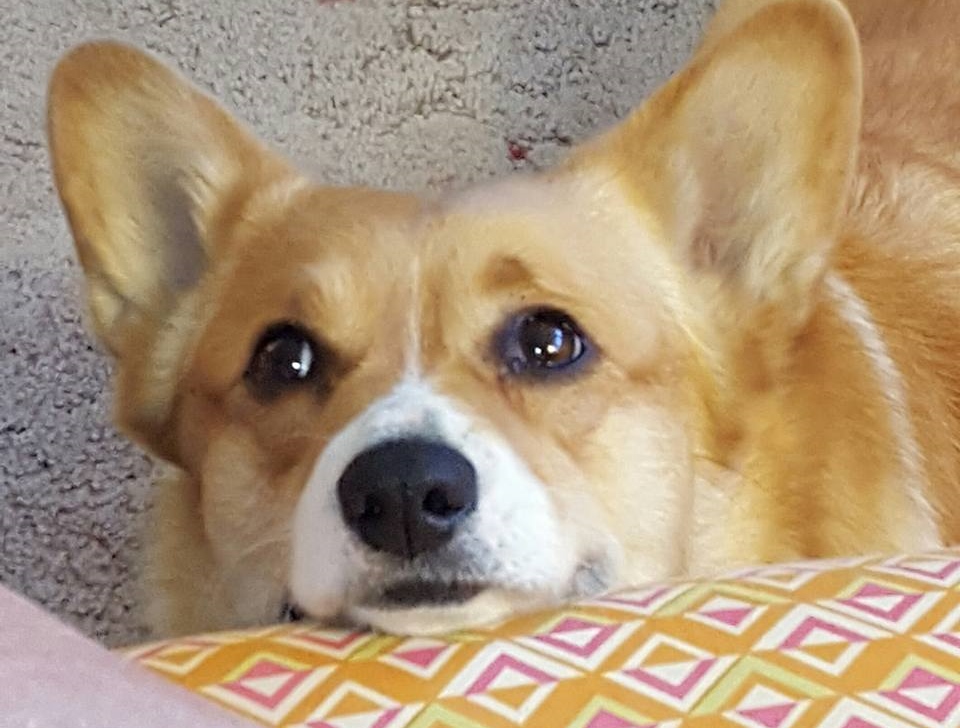
You will find bits and pieces of my hobbies, my grandkids and my pets, Mr. Cooper the cat and HoneyBear the corgi.


Thank you so very much, Robin, for sharing your story and love of stitching and needlework!  Your enthusiasm and enjoyment of the craft can be heard in your responses.  Your samplers and quilts are treasures!  It is wonderful that these interviews really give us the stories behind the stitches and we learn about the stitcher as if we are sitting with them having a cup of coffee or tea.  It makes such a large world a little bit smaller.  


Wednesday, March 23, 2016

Stitching Stories: An Interview with Brendon of Linen and Threads!

For this month’s interview we have a wonderful meet and greet with Brendon of Linen and Threads in Australia!  It is great to hear from one of our gentleman stitchers, and shop owner!  He shows us some of the antique samplers in their collection along with the gorgeous samplers he is working on and tells us about his stitching journey and shop shows and retreats.  Enjoy! 

Brendon, how old were you when you first picked up a needle and who taught you to stitch? 

*My Mum first tried to teach to me stitch when I was little.  Like most kids, I lost interest pretty quickly when the next shiny thing came along. 

Later when I married Karen, her interest in needlework started to rub off.  Initially I started off on tapestry and canvas work, then progressed to crewel work, now cross stitch and I am learning stump work with Tricia Nguyen’s Cabinet of Curiosities.

Do you recall what was the first sampler that you stitched?

*I remember the first sampler I started was “And they Sinned” by Examplar Dames.  This one is still going, I think will be still going for a long while, as someone else always brings out another design that I have to start. It’s one I periodically pickup and add a bit to.
    
When do you find time to stitch? Do you sit in a set place and what tools do you like to have on hand? 

*My day job has periods of 80-100 hours weeks, then periods of more normal 40+ hours.  So stitching time is dependent on work schedule.  Normally I will stitch in the evening after dinner whilst watching TV.  I’ve got a corner of the lounge room setup with my stitching library, Ottlite and all the projects I am currently working on.  I am normally joined by at least one of our three whippets looking for attention.


Do you use the stick and stab technique, or a sewing stitch?

*I’m a “Stick and Stab” kind of guy. I know it takes longer to stitch this way, but as I use a frame, it is easier, and I find I get a more even, neater stitch.
    
Do you prefer to stitch in hand, or with a hoop or frame?

*I like a tight work surface, so always use a frame.  I have tried stitching in hand a few times, but grip the linen so tight, I end up with cramps in my hands.  For smaller projects, I like Q Snaps.
    
What is your favorite linen and thread?

*I really like the look over-dyed threads give to needlework, so tend to be drawn towards Weeks Dye Works, Classic Colourworks and Gentle Arts threads.  I have recently discovered the range of stranded cotton from Valdani, the colours look great and I am going to order some in.

I mainly stitch on 40ct linens, either Antique White or a hand dye, though I have some 56ct I am going to try one day.
    
Do you like specialty stitches and have a favorite?

*Specialty stitches make samplers interesting, providing a break from cross stitch.  “Miss Mary Ann Bournes 1791” by Hands Across the Sea Samplers has a lot of satin stitch and I am enjoying that.  I also do a lot of short and long stitch, and am currently learning variations of buttonhole stitch as part of the stumpwork course I am doing.


What is your favourite period of sampler-making and why?

*It is really hard to pick a period.  I love samplers from the each of the three peak periods for sampler making.  The late 17th Century was the peak of stumpwork, with amazing craftsmanship, hidden political meanings and some truly amazing designs with elaborate embroidered cabinets.  The 18th Century, with naive designs incorporating motifs, bright colours and pictorial samplers.  Then the 19th Century, a more refined period, with samplers featuring ornate borders and grand houses.
    

Which designs appeal to you the most?

*I am really drawn to samplers featuring Adam and Eve, houses and ornate floral borders.  Also, add a mermaid to a sampler, and I have to buy it.  I also like Dutch samplers and samplers featuring ships.

 Has working with reproduction samplers given you any new insight into the lives of the girls and women in the 17-18-19th centuries that you did not realize before?

*I spend a lot of time researching the history of samplers, recently giving a talk to a group of ladies at a stitching retreat.  It’s amazing when you look at the beautiful samplers stitched by young ladies, sometimes on really fine counts of linen or silk gauze and realise that they stitched by candlelight without magnification.


One surprise fact I found was needlework wasn’t always considered a feminine art.  During the Medieval period, needlework had been practised by both men and women through trade guilds and associations with needleworkers held in as high esteem as famous painters and sculptors.  As time moved on, this gender balance and perception changed.  In the late 19th Century, the Victorians started to redefine gender rolls and femininity.  Rewriting history, Victorians redefined the art of needlework as a traditional feminine art, a legacy still attached today.
    
How do you display your stitched samplers?  Do you frame them?  Hang them singularly or in groupings?  

*Everything we stitch pretty much ends up as samples in the shop.  The displays in the shop constantly change, as new samples are completed.  Here are photos of same of the samplers at the shop at the moment.


Do you collect antique samplers? Or have any other collections special to you?

*I love old samplers and as funds allow, have begun to collect them.  I’ve been really lucky, getting some great samplers, with 7 in the collection to date, some of which we have started to reproduce under the brand name “Under the Hedgerow”. 

The first one we have reproduced is “Jane Johannah Wilkins 1884 Sampler”.  We reproduced this sampler for our antique sampler retreat last year.


 My favourite at the moment is a little basic alphabet sampler.  What makes this special is that it is a real Australian sampler.  We purchased Emily Trump’s sampler from her family and have been able to track back the slightly scandalous history of the young lady who stitched the sampler, even visiting her grave.   


I recently acquired a really nice Adam and Eve sampler that I really love and have started to chart.


What brought you to opening your own shop?  Where are you located?

*In 2000, Karen was frustrated that she couldn’t get the designs and materials she wanted to stitch.  Rather than continue to complain, we decided to do something about it and began to import from overseas. 

In 2001, we started trading online as Dragonfly Dreams.  Soon we had too much stock to keep at home, so opened a shop.  Unfortunately, once we opened a physical store, the name started to cause a few issue, with some phone calls from people wanting to order Chinese food, and weird men looking for “massages”, so we had to rebrand. 

We have been in our current location for 12 years now.  Linen and Threads shares a little cottage in Katoomba, a small town in the Blue Mountains, west of Sydney.


Do you have shows where you sell your wares?   Please let us know where you are planning shows. 

*As well as the shop, we also hit the road and do many craft shows, guild meetings and retreats.  Each year we have a stand at some of the Craft and Quilt Shows, this year we will be at the Sydney show in June and the Canberra show in August.  We also attend some of the CraftAlive shows, recently we were at Castle Hill.  Later in the year we will be at Orange and Wollongong, and maybe Tamworth.  Next year, we hope to do a lot more shows, getting to other parts of Australia. 

Here is a photo of a recent stand at Castle Hill.


Any guilty secrets to confess? 

*I do everything you shouldn’t when I stitch.  I eat, drink and let my dogs lay in my lap.  So far I have been lucky and haven’t had any major disasters.
    
What has been your worst needlework disaster?

*My Ottlight has a magnifier.  I stitch near a window, during the day the blinds are normally closed, but once I forgot.  Luckily the cushion on the lounge only had a little scorching and I didn’t burn the house down.  Needless to say, the magnifier now has a sock covering it when not in use.
        
What sampler are you currently working on now?  What do you most enjoy about it? 

*I have a few samplers going at the moment, as well as some other stitching projects.  As I said before, I am working on “And They Sinned”, will probably still be working on this one in 10 years’ time!

The other sampler I am stitching is by Nicola and Sandra from Hands Across the Sea Samplers, “Miss Mary Ann Bournes 1791”.  I really love the bee skep on this sampler, though it will be a while before I get to it.


What other hobbies or interests do you enjoy? 

*As we live in Katoomba, but I work in Sydney, I spend a lot of time travelling each day.  My commute is 6 to 7 hours a day, so I need something to keep me sane.  Public transport can get pretty crowded and the trains are pretty dirty, so stitching is not an option.  To pass the time, I tend to read, and the Kindle has become my best friend. 

I have a couple of favourite books that I have read a bunch of times, each time finding something new in them.  The first is William Golding’s Lord of the Flies and the other is by Stephen King, The Stand.   

I also love to travel, we go to the USA once or twice a year to attend tradeshows and always manage to couple it with a holiday.  I love just getting in the car and seeing the countryside.  I think we have been to over 20 states so far.  We recently got back from three weeks in the UK.  This trip was just a holiday and we managed to pack in lots of history and saw heaps of needlework beautiful needlework, including Nicola’s amazing sampler collection.


Thank you so much, Brendon, for sharing your story and your samplers with us!  Seeing your beautiful stitching and wonderful antiques is such a treat!   Thank you for sharing photos from your shows and retreats.  I am sure we all wish we could spend a bit of time shopping and hearing more about the history of samplers!  Not only have you inspired us to get stitching but also, perhaps, to plan a trip Down Under!  To learn more about Linen and Thread’s offerings, retreats and future endeavors please visit their website at Linen and Threads.