Friday, May 13, 2016

Stitching Stories: An Interview with Moira Blackburn!

Today we are revisiting our interview with Moira Blackburn and featuring her samplers and designs for our sampler party weekend!  It was Moira’s beautiful samplers that introduced Nicola to the world of stitching and love of samplers.  Moira has graciously given us an inside look on her journey in stitches and to reproducing and creating her very own samplers and company!  She gives us her thoughts on the young girls who stitched samplers hundreds of years ago and tells us about her favorites.  Enjoy! 


Moira, how old were you when you first picked up a needle and who taught you to stitch?  What was the very first sampler that you stitched?

*I learned a can-do attitude from my mother so was knitting and sewing doll clothes around age 8.  I completed my first sampler in 1981 which I wasn't very happy with but I missed stitching so much when it was finished that I went on to stitch large samplers for my 3 children.

When did you start charting reproduction samplers / designing your own samplers?

*When my youngest child started school in 1988 I got the idea that producing sampler kits could be my occupation. I loved stitching, I had worked in design, had a passion for researching samplers and a belief that I could bring more authentic-styled samplers to the market.

What was the first sampler you charted?

*The Time and Season Sampler was one of the first five designs I produced as a kit and has proved to be a best seller for over 25 years.       Charting was done by hand on to graph paper back then, first in pencil and then in pen, any mishaps would involve starting all over again.  Patience became my middle name!


Can you tell us about your creative process of reproducing samplers / designing samplers?   What inspires you?

*Samplers of the 19th century have been my inspiration and my study.  I often would start with a verse that had a special meaning for me and the line lengths would determine the orientation of the design.  Sometimes the design would come first and I would make trouble for myself in finding a suitable verse to fit.  I loved the search for words as much as the search for motifs or borders which I could use from original sources.  My designs developed in the stitching and searching simultaneously, often evenings of no stitching while the choosing and rejecting went on.  Even behind my eyelids before I slept.  

Reproducing an original sampler completely is down to counting through a magnifying glass and transferring what you see.  It always felt like a privilege to be touching close to the work of a child from the distant past.  The true colours can be seen on the reverse of the sampler, which can be surprising. 

What is your favorite time of day to stitch?  Do you sit in a set place and what tools do you like to have on hand?

*During my busiest years producing the kits my children were still young so the school hours were spent filling orders and my stitching and designing hours were confined to the late evenings and into the night and a daylight lamp was my most essential tool.  Since the years and children flew and I have more time and daylight, I have to admit to getting much less done.

Do you use the stick and stab technique, or a sewing stitch?  Do you prefer to stitch in hand, or with a hoop or frame?

*I use the stab method of stitching and always use a frame as I like the fabric to be under tension.  I have a lovely, varied collection of wooden frames but ultimately choose to use the hollow tubular plastic frames as they are light and reliable tight.

Do you have a favorite linen?

*My sampler designs and reproductions reflect the period they were first made so my preference is for unbleached and darker shades of linen.  Belfast 32count and Edinburgh 35c Zweigart linen.

What is your favourite period of sampler-making and why?  Which designs appeal to you the most?

*Elizabeth Oliver's sampler epitomises the type of sampler I like best. I was given permission to reproduce this sampler from the collection in the Castle Museum in York.  Houses, birds and animals and the irregularities in the work of a child's hand all appeal to me.  I have stitched 3 Quaker samplers from other designers just for the pleasure and love the Quaker alphabets. 


Has working with reproduction samplers given you any new insight into the lives of the girls and women in the 17-18-19th centuries that you did not realize before?

*Inevitably the class or wealth into which the stitchers were born does make a difference.  Whether you were the lady of the house stitching for pleasure, or the young woman stitching marking samplers to enable herself to get employment in the houses of the wealthy.    A lot of samplers were made sadly to record multiple deaths of siblings.  Some demonstrate a strict religious discipline.  I think it's clear that many samplers were made under difficult circumstances and that we are very fortunate to be stitching for pleasure.

How do you display your stitched samplers?  Do you frame them?  Hang them singularly or in groupings?  

*I do frame my samplers and have previously hung them in groups however the house I live in now is more suited to hanging samplers singly.  I have shared a lot throughout my family and have a lot of my stitched models in storage.  I have the Time and Season Sampler hung above the bed in my guest room and Rebecca Robinson's sampler above my own.  I find I admire the samplers of another’s hand more than my own.

Do you collect antique samplers?  Or have any other collections special to you?                                                                                                                                                      

*I do have a small collection of Antique Samplers which I love.  I also have quite an assortment of hare ornaments as the hare running through the letter M has been my logo from the beginning.                                                                                                                                      

Do you have other types of hand work that you enjoy?

*Since two hand surgeries I find I don't have the ability for stitching samplers so I have a wonderful stitcher who will work my designs for me.  I do enjoy knitting and machine quilting, curtains, cushions, bags.  I have three dogs to walk and sometimes I practice trying to do nothing and to not feel guilty.  I go to a mat making group when I can and love the companionship of other ladies with busy hands, interesting stories and warm hearts.                                                                                    

What has been your worst needlework disaster?

*A sampler model which I had collected from a stitcher was stolen from my car along with other items.  The worst part was knowing that it would probably have been discarded as unwanted.  I have three excellent linen tea towels which started out as new sampler designs and were abandoned as not working out at early stages.  Waste not want not. 

Are you currently working on a project that you can share with us?

*I don't have a design in progress at the moment as I am planning to retire and pass on the production of my kits and charts to others. When that is accomplished I hope to get back to designing and can feel the little itch of ideas already. I'm so happy that the market place is now rich in designers and wonderful sampler designs.

If you can pick just one, which is your favorite sampler that you stitched?  And why? 
                                                                                                                                                                                     
*The Keep Me Sampler.  I have chosen this example as it most closely represents the type of sampler I am most fond of.


Thank you so much, Moira, for sharing your story and your samplers with us!  Seeing your beautiful works will pass your inspiration along to others just as Nicola was inspired years ago.  It is so important to pass along the inspiration and keep the love of stitching alive.  We will all be wanting to pick up our needles today and stitch away.  To learn more about Moira’s collection of samplers and future endeavors please visit her website at Moira Blackburn Samplers


Friday, May 6, 2016

Stitching Stories: An Interview with Erna Hiscock of Hiscock & Shepherd Antiques!

For our May interview we ‘visit’ with Erna Hiscock of Hiscock & Shepherd Antiques in England!  Erna tells us about how she started collecting antique samplers and shares a few of her favourites with us!


Erna, when did you start collecting antique samplers?

*I started collecting antique samplers over 40 years ago, in about 1971. 

Do you remember what antique sampler first caught your eye?  Is it still in your collection?

*Yes!  A miniature memorial sampler commemorating the life of twins.  I do still have them, I consider my samplers as individuals bought for £22.


What special attributes do you look for when choosing antique samplers to add to your collection? 

*My girls are all individuals and so must have a personality. I do particularly love miniature samplers and those associated with school work.

Can you explain how quality, age and origin determine the value of a sampler?

*There are so many aspects of a sampler that determine its value.  Yes, a 1799 sampler is probably more than an identical 1801 but also look for finest, stitch type colour and condition, but also historical significance.

What was the most unlikely place that you found/obtained an antique sampler?

*In a lot of wooden boxes, folded, and probably untouched for 200 years.

How many samplers do you have in your collection? 

*Probably 100!

Can you perhaps share two or three of your favorites and tell us about them? 

*Here are a couple of favourites, it is a bit like asking who is your favourite child!


1803 Heart, was bought for me by John.  It relates to a particular School I’m interested in, the girls were allowed to sell needlework items for pocket money. 


The 1841 sampler is the most perfect miniature of a larger sampler only 9.5 x 12.5 cm and was made in a school in Van-Demon land in Australia.


Mary Catharine Harris 1873 - who couldn't love that Zebra!

  
What is your favourite period of samplers and why?  Which designs appeal to you the most?

*I do like all samplers so no real period, possibly the late 18th and early pre 1840 School samplers for their historical history in the development of education. The Samplers of Ackworth, Bristol and Cheltenham orphanages.


Has collecting antique samplers given you any new insight into the lives of the girls and women in the 17-18-19th centuries that you did not realize before? 

*Yes, with research now one can rarely connect with my girls and their lives, I find it amazing that these young children long forgotten are now being talked about loved and admired in a way they could just not imagine.


How do you display your collection?  Do you keep the in the original frames?  Hang them singularly or in groupings? 

*We hang them in groups, occasionally a larger one is hung on its own. We do keep their original frames if possible.


Is your collection on display in a gallery?  If so, where… so we may all visit!? 

*Our collection is displayed in our home, and yes, we can arrange visits.


Have any of your samplers been reproduced?

*No, they have not been reproduced.


Apart from antique samplers do you have other special collections? 

*I do love associated sewing items, pin balls, and watch samplers and early needlework.


Thank you so very much, Erna!  It has been an absolute pleasure to hear more about your antique samplers and when you began collecting.  Thank you for sharing your favourites from your collection.  They are quite unique and endearing. 

For those of you with a subscription to Homes & Antiques magazine, take a peek inside to see more of Erna’s collection featured in the May issue.  And, to keep up on fairs and exhibits where you can enjoy seeing their wares in person in the UK please visit her website at www.ernahiscockantiques.com!


Friday, April 22, 2016

Stitching Stories: An Interview with Margriet Hogue of The Essamplaire!

What a special treat!  We meet Margriet of The Essamplaire about learn about how she got started in stitching and her love of samplers and reproducing them.  While our journeys are all similar we have all followed a different path to get to the same place, a love of reproduction samplers.    


Margriet, how old were you when you first picked up a needle and who taught you to stitch? 

*My mother taught me to stitch around age six or seven, the first thing I did was a stamped pattern. 

Do you remember what sampler you stitched first? 

*It was a sampler from a Dutch magazine and can't remember the name of it but it wasn't very large.

When do you find time to stitch?  Do you sit in a set place and have favorite tools on hand? 

*If I'm on a deadline I will stitch all day but generally I will stitch in the afternoon and in the evening. I move to different places for stitching, especially if I'm doing very fine work, then I tend to sit in front of a window for better light.

Is there a stitching method that you prefer, such as stick and stab technique, or a sewing stitch?  

*I learned how to stitch using the sewing method and generally use it unless it is something that needs to be stretched then it's two handed and more often than not I end up with loops on the back that I end up stitching over.

Do you have favorite stitching supplies?  A favorite linen?  Do you prefer to use silk threads?  

*I pretty much always use silk threads, I find that I'd rather use those if I'm spending all this time on it.  I like Zweigart linen the most.

Is there a specialty stitch or embroidery technique you enjoy most?  

*I like most stitches but to be honest queen stitch is my least favourite, looks nice but takes too long.

How did The Essamplaire start? 

*I came across a sampler in a Dutch magazine and made it and then another one from a Dutch magazine.  Then, I bought a kit, which I never did finish and thought I can do this.  Whenever we would travel I'd make appointments with museums to look at their samplers and get permission to reproduce them.  I started buying antique samplers, as well, and reproduced those.  Early on I sent images of six samplers I had done to Country Living magazine and they featured them in one of their issues and the rest as they say is history!

What do you look for when choosing a sampler to chart for your collection?     

*It has to be appealing to the eye, some have a naivety to them or a folky look and others are just pretty to look at.  I also look to see if they belong to a particular school or area and preferably they have a variety of stitches.

What is your favourite period of sampler-making and why?  Which designs appeal to you the most?

*Can't say that I have a favourite time period, it changes from time to time.  For a while I really liked 17th century samplers and then after stitching those for a bit I need a change and do something a little simpler and less time consuming.  But I do go back to them.  I always like Scottish and Dutch samplers. Love some of the American ones.
  
Has working with reproduction samplers given you any new insight into the lives of the girls and women in the 17-18-19th centuries that you did not realize before? 

*You can't help but learn about the girls and women's lives that stitched these samplers, you wonder where they were, physically, while stitching, if they enjoyed it or was it something that had to be done.  Some girls hated it, I'm sure they would rather have been outside running around.

What aspect(s) of working with early textiles appeals to you the most? 

*The history behind them.

How do you display your stitched samplers?  Do you frame them?  Hang them singularly or in groupings? 

*I used to frame them but now they are rolled up or laying flat in an acid free box.  I do have some grouped together on a staircase wall.

Do you collect antique samplers? 

*I do collect samplers, I used to try and have one of every country and then that got a bit out of hand and I sold most of those and have focused on Dutch samplers only and now in particular only orphan samplers from one particular orphanage.

Apart from samplers do you collect anything else? 

*Some pottery and art.

Do you enjoy any other types of hand work? 

*I used to weave and knit but gave those up as it bothers my shoulder too much, occupational hazard from repetitive movement.

What other hobbies or interests do you enjoy? 

*Love painting, I paint abstracts.  It's a nice change from stitching.

Any guilty secrets to confess? 

*I do drink tea and coffee when stitching and once red wine, which went down the wrong way and ended up all over the sampler.  Fortunately it came out as I ran it under cold water immediately.  I now do have some longer jumps on the back, I generally try not to have them longer than three stitches but they are longer from time to time.

What has been your worst needlework disaster?  

*See above, the red wine over everything!

Do you have a favorite sampler or one that has special meaning to you? 

*Not really, they are a favourite when I'm working on it.

Are you currently working on sampler or special project?  What do you most enjoy about it? 

*Currently working on Olivia Rebecca Parker, a sampler from the collection of Winterthur and stitched by a black girl.


Thank you so very much, Margriet!  It is wonderful to hear about how you got started and learn more about The Essamplaire.   Please visit The Essamplaire website at www.theessamplaire.com to browse their full collection of antiques and samplers.  There are so many beauties, they will be hard to resist!   Margriet also offers online sampler classes, a great way to learn advanced techniques!  


Sunday, April 10, 2016

Stitching Stories: An Interview with Robin!

For our April interview we meet with Robin of Montana! 

Robin truly loves needlework in many forms and we are delighted that she is sharing her works with us today!  From beginning to end, it is a feast for the eyes in color and craft, of samplers, quilts, knitting and more.  Enjoy!   


How old were you when you first picked up a needle and who taught you to stitch?

*I didn’t have anyone in my life while I was growing up that did needlework. It was all pre-destined in my mind and hands that I would do such activity. I knew there was something, but how does a small child put their thoughts into context of what it all means? Honestly, at 6 or 7 years old I used to cut out the quilt block patterns from the Kansas City Star newspaper when it would arrive at my grandparents house in southeast Colorado. I didn’t know what I was going to do with them, but I knew I wanted them and I knew I loved the word “quilt”.

We had a small fabric store in the downtown block that was called Shulls Fabrics and a Woolworth Five and Dime store that had “embroidery stuff”.  I went into Shulls as a small child and I can remember seeing the bright cotton embroidery threads and patterns, yarn, and fabric (to the ceiling). Mr. Shull was a German speaking gentleman that cut your fabric for you. I remember making a bee line for it when I was about 10, with my babysitting money in my pocket, and I bought a blue Susan Bates hoop, DMC or J&P Coats cotton, a package of two pillowcases, needles and I was off and running. The package had instructions on how to do the stitches and that is how I learned. I would eventually buy a stamped “sampler” with cross stich on it or crewel stitches, but I don’t know what ever happened to those. My mother was not a saver, she was a place for everything and everything in its place lady and there were no mice in our house because the floors were spic and span.

That same year I taught myself to knit. There went the rest of the babysitting money. The library was my friend for knitting stitch dictionaries.

I have to tell you a story. My brother and I were 18 months apart, which made us mortal enemies. One year, while I was in high school, he drew my name for the Christmas gift exchange. When I opened it and saw the stamped dresser scarf, cottons, needles, hoop, I’m sure I cut my eyes at him and mumbled thank you; but inside? It was THE best gift I could have ever gotten.   I knew my mom was behind it, but it was never spoken out loud; my brother got one point.

Right before leaving for the U.S. Navy in 1979, I became friends with a neighbor lady who had shown me all of her handmade quilts in her home. I was speechless. Now I knew what I would do with the quilt block patterns…but I was out of time. It was time to leave.  Fast forward through boot camp and schooling and I went to my first duty station, Guam, as a Cryptologic Operator. There was a community center on our base that was advertising quilt making! Eureka! I enrolled immediately and the rest is history. My cross stitching method is based on the hand sewing of quilt seams and quilting that I have done all of these years now.  While on Guam, cross stitching was just starting to become popular and I played around with a few smalls, but it didn’t last. Then the Paula Vaughn patterns came out in the 1980’s, with some linen, and I tried a few, but never finished them. That was the extent of cross stich until now; until reproduction samplers.

Do you recall the first sampler that you stitched?

*Yes, because it was so recent! The House on the Green Lawn Sampler by Ramsgate Ltd.


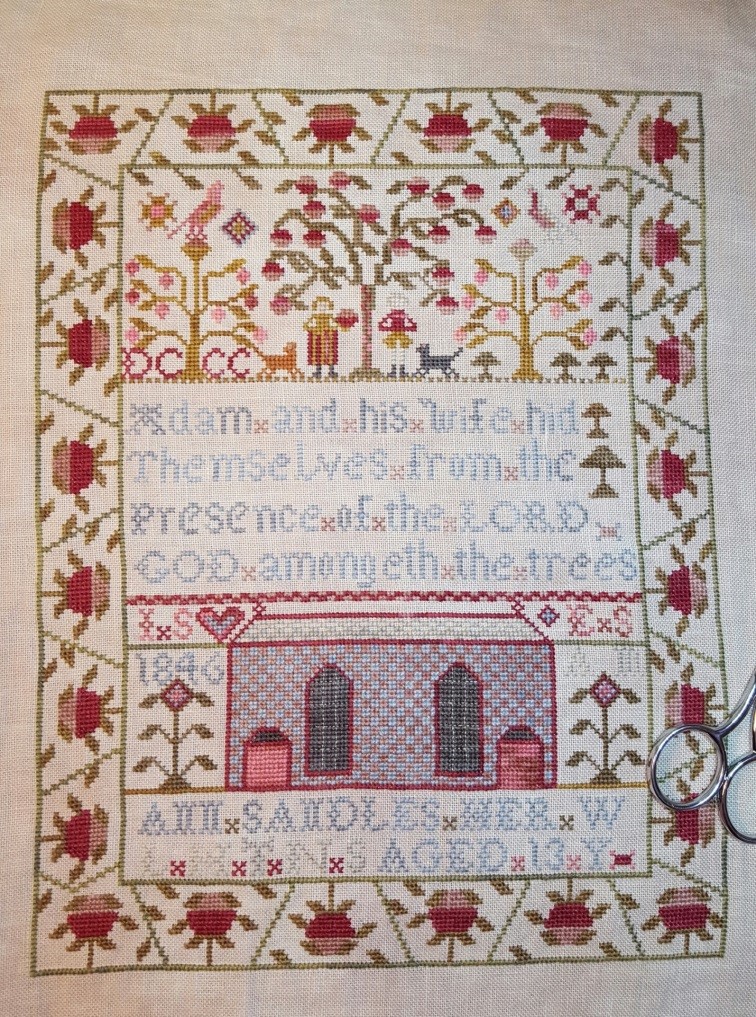
I found this kit (pattern and fabric) in an antique store in Alpharetta, Georgia in 1987.  Since it was cute and it was related to needlework, it came home with me, unopened.  I was too busy quilting and knitting.  Fast forward 25 years and as I was scrolling through the blog roll on the blogs I read, I had to hit the mouse brake! I had just seen the most beautiful piece of something in my life. It was Ann Dale by Shakespeare’s Peddler and it had been stitched by a knitter, who I am sorry, I can’t remember whose blog I saw it on.  I started searching for this old kit I had stashed because I thought if I stitched it and it was something I really enjoyed doing, then I would purchase my first pattern/linen/threads to do an Ann Dale.  I did love the process and that began my journey into samplers.  I did not do Ann Dale next, though, I stitched Ann Sandles. Because, you know, once you have started collecting patterns, there are all kinds of possibilities!


When do you find time to stitch?  Do you sit in a set place and what tools do you like to have on hand?  

*I stitch every night, from about 7 -10. On the weekends I like to start my day in the stitching room and will pop out for breakfast but then stitch until lunch.

I use the regular tools; hoop, scissors, size 28 needles, seam ripper, Ott Light, oh, and I can’t forget the stitching glasses. I keep all of this on a wooden table tray that I can carry back and forth to whichever area I am going to be stitching. There is a wooden cup screw in the side of it on which I hang my thread bags. My Book of Days Needlework Calendar is always within reach.

I have two stitching places. One is in my stitch room, in the corner, with the light over my shoulder and my Sirius radio playing Frank Sinatra and the mess in front of me, sometimes with a cat in the middle of it.


The other one is in the living room where I sit in my green chair and can keep my husband company and watch Turner Classic Movies and the Atlanta Braves baseball team…every day…every game.


Do you use the stick and stab technique, or a sewing stitch?

*Sewing stitch. I will stick and stab when there is a need, for instance when I do over one. I sew from right to left and complete each stitch as I go, unless there is a need to do a return journey.

Do you prefer to stitch in hand, or with a hoop or frame?

 *Hoop first, in hand second


What is your favorite linen and thread?

*I use 36 and 40 ct Lakeside Linen (all colors) and Newcastle 40 ct (several colors) and Edinburgh 36 ct raw natural. I have recently discovered 34 ct Legacy from Access Commodities, and I have to say, it is wonderful.

I use silk thread 90% of the time, but when I want to use a different count of linen, such as 32 or 34, I will use a double strand of dmc.  I love their colors and sometimes I want a heavier coverage. I have used overdyed cottons, but I find that I don’t get the saturation of color that I prefer.   

Do you like specialty stitches and have a favorite?

*I like specialty stitches in a sampler, but not the whole sampler.  I am fond of the Queen Stitch and the French Knot.  I like freehand embroidery, so I will say to you at this time that whatever it takes, I don’t mind doing it…except marking stitch…oh, did I say that? LOL
    
What is your favourite period of sampler-making and why?

*I am partial to the history of our country, so 17th, 18th, 19th century. These sampler patterns are a part of that history.  My maternal ancestors hail from New England and some from up in Quebec (French trapper marries Indian princess and eventually migrate south), so I am interested in that area of the country for historical life style.
   
Which designs appeal to you the most?

*Color rocks my world, I have to have it, just look at my stitching room! So I go for the brighter samplers (Harriet Redfern, you are close to the top of the que!). I am a folk lover at heart and red is my favorite in a sampler. I love scenes, with houses, yards, fences, grass, animals, sun/moon, American, Balch style, etc.  I get all giddy about larger than life people figures being bigger than the buildings and a cow standing out from the other motifs, especially a spotted one or a blue one.

But, I also am attracted to Spot Samplers, which seem to be more European than American. And I can’t forget the Saxony type of samplers; there is something about those long, thin samplers with motifs on different apartment levels that I really like.

Has working with reproduction samplers given you any new insight into the lives of the girls and women in the 17-18-19th centuries that you did not realize before?

*The one new insight that I have learned is that there were even samplers at all. I knew that girls learned to do embroidery, but I was not aware that there was a whole world of samplers out there that had been preserved and are in museums for us to enjoy.
   
How do you display your stitched samplers?  Do you frame them?  Hang them singularly or in groupings?   

*I only have one framed at this time. Right now my focus is the stitching of the samplers. It encompasses my life. I have samplers being stored in an archival box. I do take them out and put them in order of which ones to frame next, but honestly, I would rather be stitching and spending money on the patterns that will go out-of-print, or the linen that will no longer be available, or the threads that will change dye lot if I don’t get them all at once for a kit I’m doing.


Do you collect antique samplers? Or have any other collections special to you?

*I do not collect antique samplers; I’m afraid I would need smelling salts if I had access to antique samplers. But I love looking at them every day, thanks to technology that enables us to enjoy them in computer form.

I collect reproduction sampler patterns; over 700, of which over 50 are Scarlet Letter and I do have some smalls and prims.  Is there any one experienced out there that could help me determine how many I need? LOL

I collect antique quilts, vintage tablecloths, embroidered pieces, wooden dough bowls; and old books that are mysteries and are readable, hold a charm for me too. 

Does fabric, wool, quilting/knitting books count?  Because if they do, I am the mecca of the museum world for the future.


What other types of hand work do you enjoy?  

*Hand piecing/hand quilting, with red/green applique and scrap quilts being my favorite. In recent years I had started to collect antique quilts based on the feeling that I would get when I touched them. If I felt the makers presence through my hands, I would buy it and then trace the block pattern and reproduce it to try and keep the old patterns alive.

Here are two pictures of a few of mine that I have made. The first one was photo bombed by HoneyBear.


Here is a picture of two of the antique quilts and the reproduced hand pieced blocks that I made directly from the quilt top. The basket had been green and faded to tan.


 Knitting: my favorite being fair isle, aran or lace. I only use wool and most of that is Shetland.  A dream of mine would be to travel to the Shetland Isles and give the sheep a bear hug to thank them for giving us this renewable resource. A lace shawl in homespun yarn (not spun by me) and a Fair Isle vest in Shetland Wool.


Spinning, Crochet, Embroidery, and Basket Making for a bit, but I had to finally give something up; I needed sleep.  Years ago I would sew all of our clothes, man/woman/child, but I quit after clothing my first granddaughter.

Doll making. This one has an embroidered face, a circular shawl that I started knitting and pulled off the needles to unravel and make look forlorn, a knitted scarf, broken knitting needle being repurposed and the bottom skirt is half of an embroidered table runner that had holes in it. This doll represents Baby Doe Tabor. She died in a mine cabin, broke and destitute after the big silver run in Leadville, Colorado back in the 19th century. The face is embroidered, taken from a pattern from a book, the rest is mine.  My grandson is afraid of her so she has to turn and face the wall when he is there.


Any guilty secrets to confess?  

*I will have water, coffee or Pepsi sitting next to me and more times than not there is chocolate lurking. Oh, and I think this is taboo for some people, but I do moisten the end of my thread before threading the needle.

What has been your worst needlework disaster?

*Ugh, I was continually cutting my linen threads while frogging! I know how to weave and fix it, but still!  Then I read this great tip about using a seam ripper instead of scissors to remove your stitches (Hi Donna!). Now I go across the top of the row catching just the top leg of the thread and then turn it over and pull the stitches out. Whew, that nightmare is over.  I was usually frogging a color concern, not a mistake.
   
If you can pick just one, which is your favorite sampler that you stitched? And why?

*I am going to have to go with Ann Rayner. I just couldn’t get enough of her colors; so bright and beautiful.  Look at those bigger than life people and smaller house! My second favorite would be anything I’m stitching now.


What sampler are you currently working on now?  What do you most enjoy about it?  

*Oh, did you actually mean “samplers”?

I am totally smitten with Mary Ann Hoover, The Essamplaire. I can’t wait to get to all of those leaves, made out of lazy daisy stitches!  The “e” in the word “renew” is giving me a twitch and may be “fixed”.


Susan Singleton, Scarlet Letter.  Who doesn’t love the colors in this sweet sampler?  And look at the difference in the size of that deer to the house. Love it. Don’t pay any attention to the white in that berry, I was experimenting and it will be changed.  And remember, follow the pattern and not the picture and your house will look like mine.


Sarah Williams, The Essamplaire. I am anxious to get to the little dog, so I can make it a Welsh Pembroke Corgi, because after all this is a Welsh sampler and Corgi’s come from Wales.


What other hobbies or interests do you enjoy?  

*We don’t travel long distances because we are home bodies. We live in Montana, USA and are right in between Yellowstone National Park and Glacier National Park, 2.5 to 3 hours either direction. So we can do a day trip or we can stay a night; after that I get antsy because I want to be at home stitching!

We traveled to the Canadian Rockies a few years ago and I stopped and visited Margriet Hogue (The Essamplaire) or I should say I stopped and contributed to her income; no what I mean is that I was able to view and hold the most beautiful pieces of needlework that I’ve ever seen. To see and hold them in real life is a surreal experience. Piece after piece came out of that box. I made my collection order immediately (I have no restraint) and now I house many kits and patterns.

I read all of my patterns, all of the time, don’t you? They go to bed with me, they come to work and get read at lunch. I take out a Scarlet Letter pattern and start with the history of the sampler and then work my way through “use 1 strand of silk” all the way to the end.

I am a 33 year Federal government employee and I am eligible to retire next January, but I have decided to stay another 6 years after that, until I am 62, just to make sure that I have a retirement that will support my new passion of sampler stitching. At which time I will start living my other dream of being a domestic goddess.

Thank you for all who do the research, the charting, the written word. Thank you, Nicola, Krista, Jo, for administering the Scarlet Letter blog and allowing us to share a part of our life and read about others; fascinating. I return to the interviews on a frequent basis.

I do have a blog that is occasionally updated, if you are interested.
Post Cards from a Montana Stitcher at needleworker2012.blogspot.com 
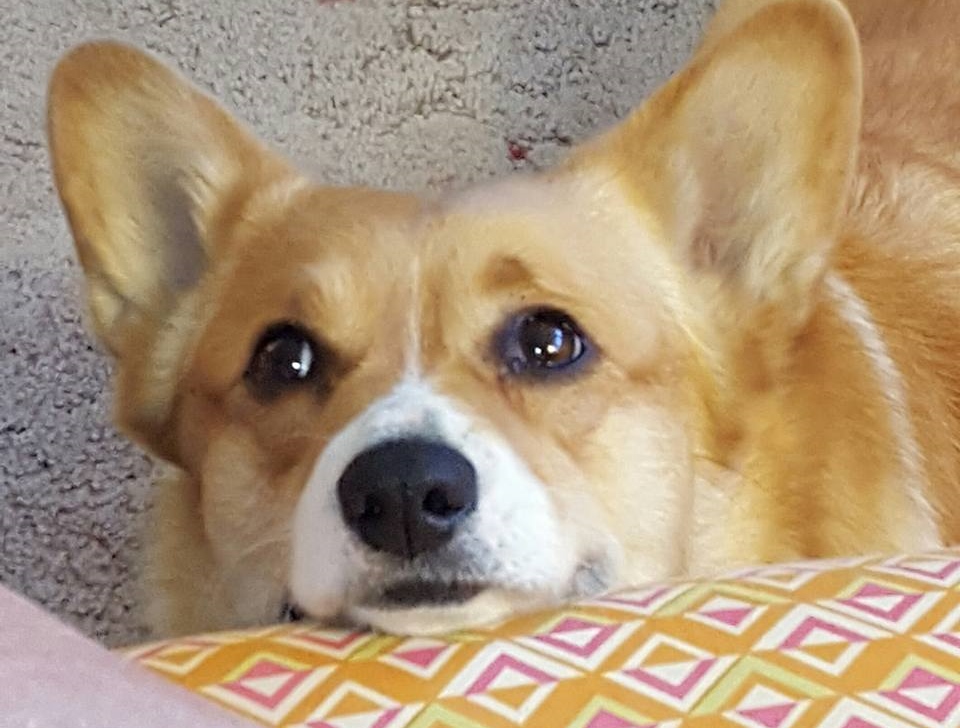
You will find bits and pieces of my hobbies, my grandkids and my pets, Mr. Cooper the cat and HoneyBear the corgi.


Thank you so very much, Robin, for sharing your story and love of stitching and needlework!  Your enthusiasm and enjoyment of the craft can be heard in your responses.  Your samplers and quilts are treasures!  It is wonderful that these interviews really give us the stories behind the stitches and we learn about the stitcher as if we are sitting with them having a cup of coffee or tea.  It makes such a large world a little bit smaller.